viernes, 15 de junio de 2018

jueves, 14 de junio de 2018
martes, 12 de junio de 2018
Interview to the society of the Industrial
Revolution
https://soundcloud.com/saul-fernandez-martin/audio-interview
Between
1750 and 1870, two very different revolutions took place simultaneously in
Europe: The French Revolution which led to political transformation and the
Industrial Revolution, which brought about dramatic economic and technological
changes. These Revolutions had an enormous impact on society; in this period
and years later.
The
Industrial Revolution began in Great Britain in the 18th century and
spread across Europe and North America over the next 100 years.
The new
Industry, which was based on the mechanization of production, technical
innovations and new ways of working, caused strong growth in the production of
industrial goods.
Industrialization
introduced capitalism as an economic system and transformed society. Cities
grew as people left the countryside in search of work.
Two new
social classes made up the backbone of society: the bourgeoisie, who had
capital to invest and the proletariat, who worked in the factories.
To have a better
understanding of the social situation BBC Radio is going to interview the
Embiid brothers.
-What age are you? Twenty-two. 24
-What is
your occupation? We both work in the countryside as peasants
-At what
age did you start working? Eight, 9
-How long
did you continue in that occupation? Until now.
-Which is your working timetable? It depends on the season.
On summer, we work from 6 in the morning to 7 at night.
-Thirteen hours? Yes.
-Do you have any break? Just for lunch and for dinner.
-Have you ever had the same timetable? From 5 in the morning
to 8 in the evening. In the beginning own a land.
-Fifteen hours? Yes.
-With what intervals at dinner? — An hour and a half
-How far did you live from the land? — About 10 miles
-So far away? Yes. Our uncle, who is the engine driver,
always take us for free.
-Was there any time allowed for you to get your breakfast in
the land? — yes. As I have told you in the beginning we worked for a guy who
was very rude and he just let us little time to have a break, but thankfully,
we own a land and we had breakfast before work.

-Have you ever been beaten by your boss? – Aaron was once,
tell him.
-Yes, I couldn’t go work during 3 days because I was
incredibly ill, and when I arrived the next day, he called me and I was beaten
by him.
-At the time when you were beaten for not going to work for
3, did you know that you were going to be beaten? — Yes; our boss used to tell
us that if we didn´t work hard enough, we could be beaten, and sometimes while
we were working we could see people coming out of his house with bruises.
-When you got home at night after this labor, did you feel
much fatigued? — Very much.
-Had you any time to be with your parents, and to receive
instruction from them? — No, they, as well as us, my mother worked cleaning
houses of the bourgeoisie, and my father worked in a different land.
-And why were you butted out? Because new machinery arrived
and many people had to be fired, and as you can imagine we got fired.
-What did you do? — With the savings from these years, and
with help of my family, we bought a land.
-What changes appeared? There were many changes. The main
change that appeared was the mechanical seed drill, which made it possible to
plough and sow so large fields with few workers. Also, other inventions, such
as the reaper, or the Rotherham plough. In addition, a new way of dividing the
land appeared, the Norfolk crop rotation, which was based on a combination of
grains and fodder crops, replace the three-field rotation system. In the same
period the Enclosure acts also appeared, which were used to concentrate the
fields of a person in a same plot. Furthermore, new crops appeared in the
cultivation system to improve the quality of the diet. E.g.: Potatoes and corn.
-Have you noticed any consequences? The main one is that we
got fired! These agricultural improvements led to a significant rise in food
production, which ensured the survival of a rapidly growing population.
-When the people were fired, what did they do? Most of them
went to the city. But this didn´t only happened in our village. In the last few
years there has been a rural exodus with the aim of working in the factories.
-Why didn´t you do the same? Despite the fact that the
cities tried to be prepared with new modes of transports, the city walls were
demolished and new neighborhoods were created.
-How is the political situation? Well, as we work in our own
land in the countryside, we haven´t had the same impact as the ones who live in
the cities. Our older brother, often tells us how bad the situation in the
factories is nowadays: lack of security often ends up in work accidents such as
amputation of limbs or even deaths. The work atmosphere is stressful and
irritating, the workers are often abused, and sometimes they can finish being
butted out because of anything. Also, the schedule was everything except of
flexible: they have no holidays, they work more than thirteen hours per day,
they worked seven days a week and only resting Sunday´s afternoon. Our brother
often tells us that he can see children working as young as eight years.
Frequently we have to give him some money to buy food, because salaries are
really low. Thank God, a new way of thinking called Marxism that is joining
workers with the aim of improve their rights.
-What do you think Marxism is offering your brother? In
first place, he is having support from those who are suffering this inequality
as well. Our brother thinks that Capitalism pretends this situation to be
continued, and the only possibility to make this change is to hang onto to the
ideals of Karl Marx and Friedrich Engels. Yes, Marxism has the target of
destroying the private property, putting it in the hands of the state, creating
a proletarian dictatorship, making the social classes and the Estate disappear,
giving all the power to the workers.
-And do you think Marxism is going to have an effect in
economy? Well Marxism isn´t going to have an impact in the economy. But,
playing devil´s advocate, Capitalism economic activities respond to the free
initiative of individuals, whose objective is the pursuit of maximum profit. It
is an unplanned system with minimal state intervention. The interests of
sellers and buyers are reconciled in the market, which is regulated only by the
law of supply and demand.
-And is Britain exporting their products to other countries?
Great Britain is the pioneer of this Revolution, so to avoid competition from Britain
and to foster the growth of their own industries, European countries and the
United States applied protectionism measures.
-Thank you. It has been a pleasure. Your welcome, Bye.
lunes, 11 de junio de 2018
División celular: mitosis y meiosis
Este trabajo ha sido redactado para la asignatura de biología en el Colegio Corazón de María de Zamora con el propósito de explicar el proceso del ciclo celular y para entender la forma en la que se dividen las células: el crecimiento y regeneración de las células somáticas a través de la mitosis y la formación de gametos por la meiosis, así como la relación que la división celular tiene con las leyes de Mendel.
 |
| Haga click en la imagen para visitar el enlace |
domingo, 3 de junio de 2018
viernes, 2 de marzo de 2018
THE FRENCH REVOLUTION SONG
This song is a
summary of the French Revolution
By Jeffrey Lewis
The King of
France was Absolute, the people all were destitute, the year was 17 and 89.
Churches paid
no income tax, neither did aristocrats and wars were costing money all the
time.
But
Enlightenment Ideas, had entered people’s ears like Liberty, Equality and
Brotherhood.
People
starved and broke under feudalism's yoke knew no church or king was gonna do
them any good.
There was
such financial crisis, the king had to
take advice, to try an old thing called Estates General government.
The estates
general had 3 votes, Nobles, Church and Common Folks, 2 to 1 the commons lose
it always went.
The commons
in frustration said we represent the nation, the nobles and the church must
lose their privileges.
And the rich
were scared for real when they stormed to the Bastille and rebellions also
broke out in the villages.
At the palace
in Versailles, the king and queen were heard to sigh when the national assembly
made a bill of rights.
Then the
Women's march embarrassed them and chased them into Paris and the church and
nobles lost their power overnight.
Arguments got
hot whether to keep the King or not, different groups saw different ways to run
the country best.
But when the
Royal family tried to flee the country in disguise, they were busted and then
put under a house arrest.
All of Europe's Kings were terrified to hear
these things, so France was threatened on all sides by enemies.
And when
these other kings declared the King of France had to spared, this made the King
of France look worse to the Revolutionaries.
They had
built a new machine the quick and painless guillotine, they said it's fairer
than the King's Medieval Torture rack.
Then they put
it on a vote and then dropped it on his throat and every king across the world
just had a heart attack.
They attacked
from North and South, and they attacked from East and West, Revolutionary
France was in a desperate state.
And when the
radical Marat was killed politically that was what it took for France's outlook
to degenerate.
The new
leader Robespierre said enemies were everywhere, and for a year the Guillotine
was working endlessly.
And though he
freed the slaves that’s true Robespierre’s head came off too and France was run
by the more moderate Directory.
But the Directory
was lame and France's only good news came from their armies now in Europe
winning more and more.
And the man
who made them win was General Napoleon and when he came back home he made
himself the emperor.
So it was a
painful climb to get from Kings to Modern times, but the French Revolution
always paved the way.
'Cause the
ideas that sparked the first, have never ever been reversed, it was biggest
change that shaped our western world today.
domingo, 18 de febrero de 2018
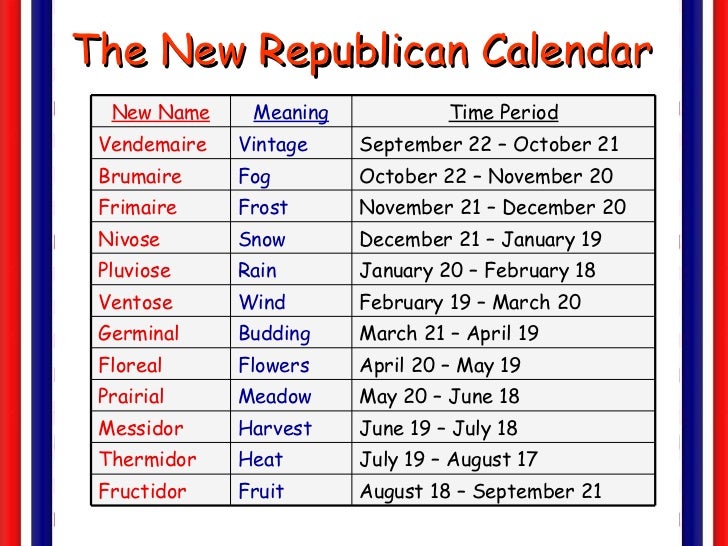
French Revolutionary Calendar
French
revolutionaries believed they did not simply topple a government, but
established a new social order founded on freedom and equality. The
year of the official proclamation of the Republic (1792) would become Year One.
In this secular calendar, the twelve months of the year were named after
natural elements, while each day was named for a seed, tree, flower, fruit,
animal, or tool, replacing the saints day names and Christian festivals. The
republican calendar was abandoned by Napoleon on January 1, 1806.
If I were living in the French Revolution I would have been born on 20 Pluviôse CCX.
Being Pluviôse
means being born in the Month of Rain.
In the
process of the French Revolution I would have been born during the National
Assembly abolished slavery in all French colonies, and proclaimed the equality
of all men, regardless of the color of their skin. Unfortunately, the
victory of the anti-slavery camp was relatively short-lived, and slavery was
restored in 1802.
 |
| This is the original calendar, written in 1792 |
 |
viernes, 24 de noviembre de 2017
Interview to a Morisco
Journalist:
Hello. My
name is Fernando. We are speaking from the BBC in London. Today we have
travelled to the 17th Century and we are interviewing a man who has
recently suffered the expulsion of the Moriscos. Tell me something about you.
Morisco:
Hello, my
name is Abdula Al Abukar and I hope to solve all your doubts.
Journalist:
How did the
government tell you the bad new?
Morisco:
In 1570 we
received a letter signed by the King that told that we had to leave Spain. It
was quite a shocking situation and my family and I thought it was a prank. We got
some information from the government and finally they told us it was true.
Journalist:
When did
they take you and your family?
Morisco:
Well, It´s
a long story.
First of
all we live in Valencia, and because as it´s one of the cities with more
Moriscos, they took us the first ones.
We had many problems because my family and I were taken in different boats,
they told us to calm down that our destination was the same. I arrived first,
and a week later my family and my sons arrived.

Journalist:
Where did
you arrive?
Morisco:
The first week I didn´t recognized the place and
anyone told me where we were. But one day I saw a sign with the name “Rabat”
written and then I realized where I was. I was in the capital of Morocco.
Journalist:
Wow! That should have been a very uncomfortable
situation.
What was your job in Spain and in Morocco?
Morisco:
I worked for a noble in a land where I was the chief,
he gave me that charge because I had been with him my entire live, and we were
near friends. He gave me a house near the land where I lived with my family. Notwithstanding,
in Morocco I work in a land that doesn´t product a lot of harvest, I have to
work more than ten or eleven hours a day, and my salary isn´t as high as in
Spain and I can´t maintain my family.

Journalist:
I´m sorry you haven´t found any other place to work.
Why do you think the king wanted you to leave Spain?
Morisco:
Well, I don´t actually know why he decided to expel my
family and me out of the peninsula.
I converted myself to Christianity, I obeyed every
single law, and I loved Spain; and if I had to die for Spain I would. Three generations
ago, my whole family converted to Christianity. Since then we have all been
Christians, and my wife and I got married in the church. I felt quite bothered.
Do you know the reasons why they expelled us?
Journalist:
Oh, I thought you knew them! Well the main reason was because
you weren´t Christians…
Morisco:
But I had converted to Christianity, and I loved Spain.
I think the decision Philip has taken isn´t the correct one. I think he isn´t
an example of a loyal king. Charles V, in my opinion, he was faithful to his
country because he respected having another religion.
Journalist:
Moving to another topic, let´s talk about your social
situation there in Morocco.
Morisco:
OK. To be honest, it´s totally different. I have no friends,
the food is different… I think I´d have to get used to live in this place.
Every one looks at me as if I was an immigrant. It´s quite annoying.
Journalist:
Yes, I can imagine it. Do your wife or children work?
Morisco:
My wife is a homemaker. She works in house and takes
care of our sons. Otherwise, my sons do not work. They start to work when they
are 12. They are know: 11, 9 and 5.

Journalist:
Do you support this behavior?
Morisco:
Of course not, I think what children should do is go
to school and learn, because I haven´t learnt and I feel like if I were nothing;
and I don´t want that for my children. I try to teach them the things I know. Has
it changed in the future?
Journalist:
Yes. Now it is obligatory to go to school. I´m so sorry
you haven’t gone to school. But it has been a slow process. Nowadays, there are
still countries that don´t have schools.
Just the last question: do you spend time with your
family?
Morisco:
Well, not a lot. I wake up early and they are still
sleeping. At lunch time, I have a sandwich at the land, and of course I cannot
see them. But when I arrive home and can give them lessons and have fun with
them
Journalist:
Thank you very much. I hope you find a better place to
live, and that you spend more time with your family. It has been a pleasure.
Morisco:
Your welcome.
jueves, 16 de noviembre de 2017
Spanish Armada
TASK 1. This is an
extract from a letter to the English government which gives details about the
progress of the Armada.
·
How useful do you think this information would be to the English
government?
In my opinion this letter had a lot of useful information that was used to
prepare the defense of the United Kingdom and also to have the details of the
ships, leaders, sailors and soldiers of the Spanish Armada.
·
Why were there more soldiers than sailors?
There were around 11000 soldiers, because the intention of Phillip II was
to conquer England to expel Isabel I of England because she was not catholic
and was supporting protestant rebels from Flanders.
Phillip II was a catholic king and wanted that the whole Europe was catholic
too.
·
How do you think the news that the Spanish Armada had
been sighted was able to reach Lord Howard so quickly when he was at Plymouth,
over a hundred miles away?
The letter was able to reach
on time to the English Government because the ship called Golden Hind saw the Spanish ships in a daily review of the sea near
the UK cost. The watchers in the coast fired a light that was repeated until
Plymouth, where the English army was. As a consequence of that, this message
reached the UK government.
·
Why do you think Howard complained to Walsingham about
the wind?
This meteorological fact was
very important in order to favor the landing of the Spanish troops.
·
Howard says that the Spanish fleet was ‘soe strong’.
What made it strong?
The Spanish Armada was so
strong because it was composed by 120 ships, with 4 galleasses and many big
ships.
TASK 4. An extract
from a Spanish captain’s account of the events. He had survived after being
shipwrecked on the Irish coast and was then interrogated by the English,
but eventually returned home to Spain.
·
The Spanish Armada fought the English fleet for two
days without losing any ships. What happened next that changed this?
This day 25 English ships came
to Callis to support the ones that were there, and in the night, they sent 6 fired
ships into the Spanish army anchored in Callis making a great ship burned and
more ships go away.
·
Why was it a good thing that the Spanish plans were
stopped?
Because the Spanish had
planned to see the prince of Parma that was giving the army 7000 men to join
them and invade England.
Also, was a good thing because
the ships that went into the sea suffered a terrible weather the next days,
changing the wind direction and making the English have advantage so they were
fired by the English army.
·
If you could change one thing to give the Spanish a
better chance of winning what would it be and why?
In my opinion the worst fact the
election of the Duke of Medina Sidonia as the leader of the Spanish fleet. He
was the general captain of the Spanish army but he was a man with no experience
in maritime fighting. His decisions went from bad to worse.
·
The English celebrated their victory with a medal
saying ‘God Blew and they were Scattered’ – how would the Spanish have
explained their defeat?
The Spanish troops justified their defeat in the bad military organization,
their bad leader and also due to the meteorological conditions they suffered.
TASK 6. Explain in a short
paragraph why many people thought that God had helped the English defeat the
Spanish Armada.
jueves, 19 de octubre de 2017

domingo, 8 de octubre de 2017
Differences between Charles V territories and Phillip II ones
I have made a little summary of
all the territories that were conquered during the reign of Charles V and
Phillip II.
Charles V:
The house of Valois ( Netherlands )
Habsburg ( Holy roman Empire )
Tratamara ( Spain )
Fernando I:
He inherited the Holy roman empire from his brother.
Phillip II:
All the territories of his father Charles V except the Holy Roman Empire and the territories of Portugal from his mother.
Charles V:
The house of Valois ( Netherlands )
Habsburg ( Holy roman Empire )
Tratamara ( Spain )
Fernando I:
He inherited the Holy roman empire from his brother.
Phillip II:
All the territories of his father Charles V except the Holy Roman Empire and the territories of Portugal from his mother.

jueves, 15 de junio de 2017
SPAIN
Spain is a sovereign state located on the Iberian Peninsula in southern western Europe.
It´s also a parliamentary monarchy according to the Spanish Constitution in which national sovereignty belongs to the Spanish people, from whom all state powers originate. This nation, which is a democratic state, is based in three main principles: freedom, justice and equality.
It´s also a parliamentary monarchy according to the Spanish Constitution in which national sovereignty belongs to the Spanish people, from whom all state powers originate. This nation, which is a democratic state, is based in three main principles: freedom, justice and equality.
Nowadays, the Head of the State is the King, called Felipe VI, and he is the highest representation of the Spanish State in international relationships since 19 June 2014. The Spanish Crown has been inherited from fathers to their legitimate sons, always following an order explained in the article 57 of the Spanish Constitution.
Otherwise, the head of the government is chosen democratically, who is the president, and whose name is Mariano Rajoy.
Otherwise, the head of the government is chosen democratically, who is the president, and whose name is Mariano Rajoy.
The judicial power belongs to many different statutes. These are the Consejo General del Poder Judicial, the Tribunal Constitutional and the Tribunal Supremo .
- Consejo General del Poder Judicial: Highest justice institution in the government.
- Tribunal Constitutional: Their duty is to assure laws and public administration's actuations respect the Constitution.
- Tribunal Supremo: Is the superior jurisdictional body and is in charge of every order except constitutional guarantees
The legislative power is held by one power:
- The Cortes Generales: Which are formed by the Congreso de los Diputados and the Senado, and it also rules the executive one.
The state is divided into municipalities, provinces and Self-governing Communities, with regard to the territorial organization.
sábado, 10 de junio de 2017
lunes, 5 de junio de 2017
AMARÁS
AL LÍDER
SOBRE
TODAS LAS COSAS
ORIGIN OF NORTH KOREA AND ITS COMUNIST REGIME
Following Japan’s defeat in 1945 the
Soviet Union and United States agreed to split the post-war control of the
Korean peninsula between them. On August 10, 1945 two young U.S. military
officers drew up a line demarcating the U.S. and Soviet occupation zones at the
38th parallel. The divide should have been temporary; a mere footnote in
Korea’s long history, but the emergence of the Cold War made this a seminal
event. Seeking to ensure the maintenance of their respective influences in
Korea, the U.S. and USSR installed leaders sympathetic to their own cause,
while mistrust on both sides prevented cooperation on elections that were
supposed to choose a leader for the entire peninsula. The United States handed
control over the southern half of the peninsula to Syngman Rhee, while the
Soviet Union gave Kim Il-sung power over the north. In 1948, both sides claimed
to be the legitimate government and representative of the entire Korean people.
RECENT NEWS ABOUT NORTH KOREA
NORTH KOREAN LEADERS
The Kim dynasty, officially called Mount Paektu Bloodline, is
a three-generation lineage of North Korean leadership descending from the country's first leader, Kim Il-sung, in 1948. Kim came to rule the North after the end of Japanese control
in 1945 split the region. He began the Korean War in 1950 in an attempt to reunify the peninsula. Kim
developed a cult of personality closely tied to their state philosophy of Juche, which was passed on
to his successors: his son Kim Jong-il and grandson Kim Jong-un.
|
KIM IL-SUNG:
Kim Il-Sung is
known as the founder and first president of the Democratic People's Republic
of North Korea. Kim was born to a small peasant family but they were soon
forced to flee following the Japanese occupation of his homeland. After
moving to China, Kim soon became radicalized and joined forces that were
committed to defying the occupiers. Even as an early teen, he was involved
with armed resistance activity and as a young man he was promoted to a
leadership role. Driven by his anti-Japanese sentiments, he sided with the Soviet
Union in the World War, where he trained and fought along with the Soviet
soldiers against the Japanese. He eventually rose to the ranks of a leader in
the Soviet military. At the end of the war, he was in a prime position to
take over the mantle of leadership of his newly-liberated country. Seizing
the opportunity, Kim and his forces soon overruled the entire peninsula but
faced stiff resistance from foreign countries. After a bitter and devastating
war, the peninsula was split in half and he became the undisputed leader of
the northern half. Combining Communist and Marxist ideology with his own
brand of Korean self-reliance, he soon forged himself as the shining leader
of a new country. After ruling his country with an iron grip for half a
century, the supreme leader passed away, leaving his country in the hands of
a virtual monarchy.
|
|
KIM
JONG-IL
Kim Jong-Il was
born the 16th of February in 1941, and died the 17th of
December in 201 was the supreme leader of
the Democratic
People's Republic of Korea, commonly referred to as
North Korea, from 1994 to 2011. By the early 1980s Kim Jong-Il had become
the heir
apparent for the leadership of the country and assumed
important posts in the party and army organs. He succeeded his father and
founder of the DPRK, Kim Il-sung,
following the elder Kim's death in
1994. Kim Jong-il was the General Secretary of
the Workers' Party of Korea (WPK), Politburo Standing
Committee member of WPK, Chairman of
the National Defense Commission (NDC)
of North Korea, and the Supreme Commander of
the Korean
People's Army (KPA), the fourth-largest standing army in
the world. Kim's leadership is thought to have been even more authoritarian
than his father's.
|
KIM JONG-UN
Kim Jong-un was born the 8th of January in 1984, is the Chairman of the Workers' Party of Korea (WPK) and supreme leader of the Democratic People's Republic of Korea (DPRK), commonly referred to as North Korea. Kim is the second child of Kim Jong-il (1941–2011). Before taking power, he had barely been seen in public, and many of the activities of both Kim and his government remain shrouded in secrecy. Even details such as what year he was born, and whether he did indeed attend a Western school under a pseudonym, are difficult to confirm with certainty. And is the one who is governing nowadays |

INSTRUMENTS USED TO MANTAIN THE DICTATORIAL
REGIME
Since the beginning of this
dictatorship in the year 1984; each leader has introduced and changed many
different laws. This long dictatorship has imposed a schedule for every
inhabitant in North Korea. There are some rules that must be done strictly, for
example, every time you see a statue or painting of the leader, you must show
devotion to it. Another rule is that in the leader´s birthday you must go to
the nearest statue and show allegiance to the leader. Also in this dictatorial
regime, you cannot find properties, and every aspect of life is controlled by
the Government. So, as a consequence, anyone who breaks the rules is sentenced
to a public execution, where everyone must go, as well as the family, who must
go to forced-labor camps, for three generations.
To sum up, the instruments and
techniques used by North Korean leaders are three:
- The control of the Government of the information and arbitrary laws.
- The imposition of restrictions
- And, the one more important I think is the lies told by the State, to make the leader seem a god to them, by watching propaganda or other lies, like, for example the number of books written by the leader.
GULAG: ITS MEANING AND SIMILARITIES IN NORTH
KOREA
The word gulag is an acronym of “Glávnoie Upravlenie ispravítelno-trudovyj lagueréi i koloni”, that means General Directions of
Field Prisons, and this is the name with which they would go down in history
for fields of work for political prisoners in the Soviet Union of Stanlin that
were spread across the coldest areas of Siberia.
In North-Korea there are also
forced-labor camps, where the people who have been disrespectful with law, or
have committed unreal crimes, and there they must stay all their life working
in fields, mines, or cutting wood without getting paid either fed (just to
survive), and the most shocking part, his or her family for three generations,
must stay there all their lives!
MAIN CHARACTERISTICS OF A DICTATORSHIP
A dictatorship is a form of
government characterized by the absolute rule of one person or a very small
group of people who hold all political power.
1. One
Party, One Leader and One Programme:
In dictatorship only one party is allowed to exist and it is the
dictator's own party. Other political parties, associations and organizations
are not allowed to function. These are banned. All opposition to the dictator
is ruthlessly suppressed.
2.
Absence of Individual Liberty:
The individual does not enjoy any liberty or rights under dictatorship.
Maximum obedience to the laws is equated to the maximum liberty. People are not
allowed any liberty of speech, association and press.
3. National
Glorification:
Dictators glorify their nations to an illogical extreme. A mad sense of
patriotism is inculcated in the minds of the people. They are made intensely
nationalistic.
The state is regarded as the march of God on earth. The state is considered
to be the end and the individual a means to that end.
4.
Glorification of War:
Dictators glorify war. War is considered to be essential for the normal
health of body-politic. The state is all powerful and it must enhance its
prestige. The dictators adopt a war-like policy and glorify brute force as the
means for achieving national greatness.
5.
Totalitarian State:
Dictatorship is a totalitarian state which controls each and every
aspect of human personality, and takes into its fold all human activities in
the social, economic, political, educational, religious and cultural spheres.
No margin for individual liberty is left behind.
6.
Racialism:
Dictators preach racialism.
COMPARATIVE ANALYSIS: NORTH KOREAN FAMILY AND
TEENAGER VS SPANISH FAMILY AND TEENAGER
If I were a Korean guy, my life would
be totally different in many ways such as human rights, technology, lifestyle…
I wouldn´t have any rights, maybe I would be in a forced-labor camp, just
because my parents have done something stupid such as cutting a rope in a mine;
or maybe I would be attending school where the only thing I learnt were lies of
my leader and of my country. I wouldn´t have any access to Internet or to any
encyclopedia. Otherwise, here in Spain I can access easily to reliable information
about our country´s history. I also can choose what to wear, where to leave,
and surprisingly, how to cut my hair, because in Korea there are just 15
different styles of hair, either for women and men; and here in Spain you can
tell your hairdresser how you want your hair has to be cut.
VIDEOS:
- Koeran War
Suscribirse a:
Entradas (Atom)